Nuisance wildlife management stops wild animals from converting conditioned attics, crawlspaces, and wall voids into nesting sites. In central Mississippi, high ambient humidity and substantial tree cover bring…
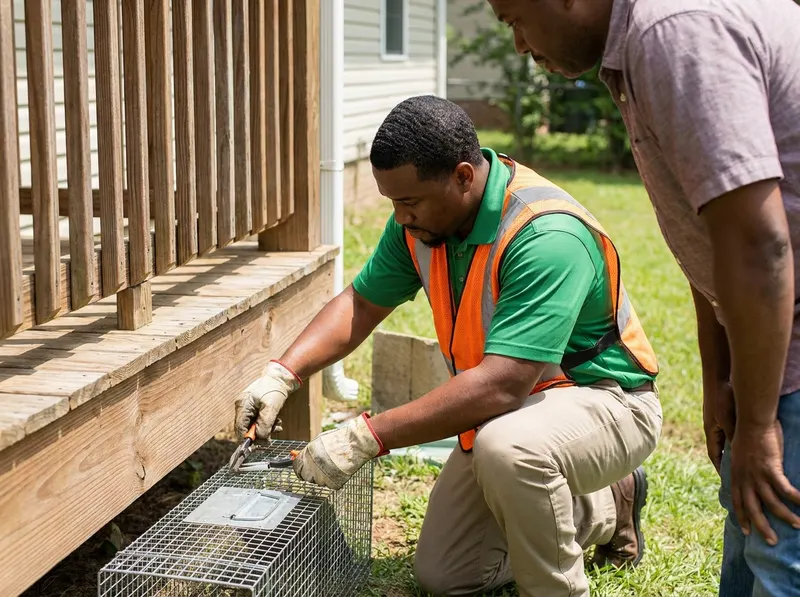
Nuisance wildlife management stops wild animals from converting conditioned attics, crawlspaces, and wall voids into nesting sites. In central Mississippi, high ambient humidity and substantial tree cover bring arboreal and ground wildlife into direct conflict with home perimeters. The trade-off between exterior trapping and complete structural exclusion centers on recurrence: surface-level trapping captures the animal currently on-site, whereas permanent exclusion seals the construction gaps, soffit seams, and gable vents to stop subsequent animals from claiming the residual pheromone scent trails left behind.
Hinds County homes face specific wildlife vectors determined by neighborhood architecture and canopy density. In heavily forested areas like Fondren, Eastover, and Belhaven, mature oak canopies bridge directly to historical rooflines, giving eastern grey squirrels and raccoons straightforward pathways to rotted fascia boards, dormer returns, and chimney flashing. Properties located near LeFleur's Bluff State Park and the Pearl River basin encounter higher raccoon and bat concentrations seeking thermal shelter during seasonal transitions. In South Jackson communities such as Woodville Heights, Alta Woods, and Broadmoor, animals frequently compromise crawlspace skirting, foundational louver vents, and HVAC duct runs within pier-and-beam foundations.
Wildlife incursions present functional structural hazards beyond standard cosmetic disruption. Rodents and raccoons tear open fiberglass batt insulation, chew through high-voltage electrical wiring, and introduce zoonotic ectoparasites such as mites, fleas, and bat bugs directly into living areas. Wildlife management operates in four sequenced steps: 1. A physical roof, attic, and foundation inspection to locate every active access void and biological deposit. 2. Deployment of species-appropriate capture devices or one-way spring-loaded doors over primary travel holes. 3. Physical reinforcement of gaps using galvanized 1/4-inch steel hardware mesh, metal flashing, and structural sealants to reject re-entry. 4. Decontamination of animal urine and guano to neutralize attraction pheromones and airborne pathogen spores. Single-service treatments do not require mandatory long-term service contracts; exact restoration pricing depends on total square footage, linear footage of ridge vent protected, and contamination levels.
Every job gets a firm, written price after a free on-site visit.
Tell us about your nuisance wildlife management job in Jackson and we'll send a clear, written quote, usually the same day.
 Darmex Pest Specialists