Venomous and non-venomous arachnids in Central Mississippi thrive due to persistent humidity and dense prey populations of beetles, silverfish, and roaches. In historic neighborhoods like Belhaven and Fondren, crawl…
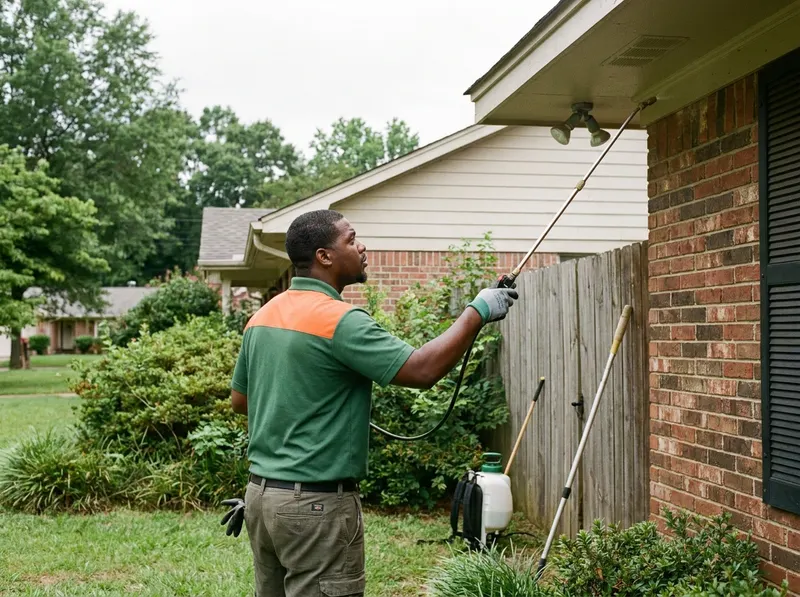
Venomous and non-venomous arachnids in Central Mississippi thrive due to persistent humidity and dense prey populations of beetles, silverfish, and roaches. In historic neighborhoods like Belhaven and Fondren, crawl space foundations and unconditioned attics serve as primary breeding habitats for brown recluse spiders. Because brown recluses prefer dry, undisturbed voids such as boxed subfloors and cardboard storage, general broadcast perimeter sprays fail to make contact with the pests. Eradication requires targeted microencapsulated synthetic pyrethroids or desiccating amorphous silica dust blown directly into wall voids, pipe chases, and attic insulation zones to penetrate protected nesting sites.
Properties near dense vegetation and waterways, including Eastover, LeFleur Bluff, and the forested margins along the Pearl River near LeFleur's Bluff State Park, encounter heavy populations of orb weavers and predatory wolf spiders. These species frequently settle around exterior soffits, window assemblies, and under outdoor security lighting where flying insects congregate. Exterior treatments combine mechanical de-webbing with extension poles up to 24 feet and an exterior liquid barrier applied 3 feet up the exterior foundation and 5 feet outward along the soil line. This dual barrier eliminates active webs and intercepts wandering arachnids moving in from surrounding tree lines.
Residential structures in Alta Woods, Broadmoor, and Woodville Heights frequently feature shifting foundations on Jackson's expansive Yazoo clay. These micro-shifts create exterior gaps around siding, weep holes, and sill plates, granting spiders direct entry into living quarters. Choosing standalone interior spot sprays leaves harborages intact, whereas pairing exterior entry-point exclusion with deep residual dusting neutralizes both the spiders and their secondary food sources. While standard liquid treatments break down rapidly when exposed to rainfall, microencapsulated formulations bond to porous brick and rough mortar, delivering up to 60 to 90 days of defensive residual protection. Technicians confirm on-site pricing following an empirical crawl space and square-footage assessment.
Every job gets a firm, written price after a free on-site visit.
Tell us about your spider control job in Jackson and we'll send a clear, written quote, usually the same day.
 Darmex Pest Specialists