Subterranean termites, primarily Reticulitermes flavipes, require constant contact with ground moisture to survive, building mud shelter tubes across foundation walls to enter wooden structural framing. In Jackson, the…
Subterranean termites, primarily Reticulitermes flavipes, require constant contact with ground moisture to survive, building mud shelter tubes across foundation walls to enter wooden structural framing. In Jackson, the dense Yazoo clay subsoils expand when wet and contract during summer droughts, creating structural shifting and foundation hairline fissures in neighborhoods like Fondren and Belhaven. These subterranean pests exploit concrete cracks as narrow as 1/32 of an inch to bypass mechanical termite shields and feed on floor joists, sill plates, and wall studs. A targeted subterranean termite program halts colony foraging by disrupting the workers before structural timbers lose structural integrity.
Selecting the proper treatment protocol depends on foundation construction, crawlspace ventilation, and surrounding landscaping. Pier-and-beam homes common throughout Alta Woods and Woodville Heights benefit from dual-barrier applications: trenching inner and outer foundation piers alongside targeted sub-slab injection under enclosed porches. For slab-on-grade builds in Eastover and LeFleur Bluff, installing an exterior perimeter non-repellent liquid barrier creates an undetectable lethal zone. Foraging workers pass through the treated soil without detection, transferring the active ingredient back to the central queen and reproductive caste via social grooming. If exterior soil cannot be disturbed due to zero-lot lines or hardscaped patios, an exterior subterranean bait matrix provides colony suppression without structural drilling, though liquid barriers offer immediate exclusion.
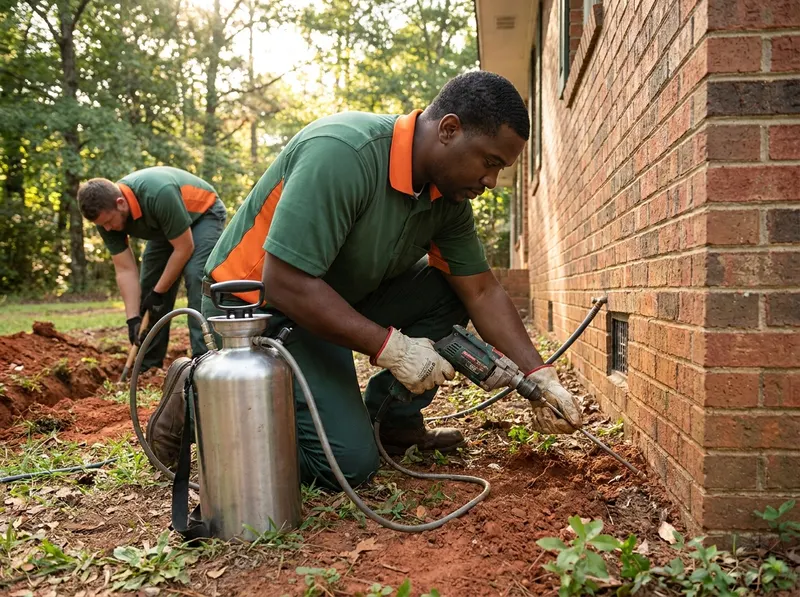
Subterranean termite management requires distinct methods compared to drywood termite fumigation. Subterranean species establish their main nesting chambers deep within Hinds County soils near subterranean water tables, rather than nesting exclusively inside dried timber. Over-the-counter perimeter sprays fail because repellent chemicals merely redirect workers to untreated foundation access points. Professional protocol involves trenching exterior soil 6 inches wide by 6 inches deep, applying EPA-registered termiticide at four gallons per 10 linear feet, and backfilling with treated soil. Technicians also treat bath trap blockouts and expansion joints, preventing hidden structural incursions beneath ground-floor living areas.
Every job gets a firm, written price after a free on-site visit.
Tell us about your subterranean termite control job in Jackson and we'll send a clear, written quote, usually the same day.
 Darmex Pest Specialists